Architecture Overview
OpenECPDS is a distributed system composed of cooperating services that together acquire, store, and disseminate data. Unlike a conventional data store, OpenECPDS does not necessarily store data physically in its persistent repository — instead it works like a search engine, crawling and indexing metadata from data providers, while optionally caching content in its Data Store.
High-level design
Data can be fed into the Data Store via:
- The Data Acquisition service, discovering and fetching data from data providers.
- Data providers actively pushing data through the Data Portal.
- Data providers using the OpenECPDS API to register metadata, allowing asynchronous data retrieval.
Data products can be searched by name or metadata and either pushed by the Data Dissemination service or pulled from the Data Portal by users. OpenECPDS streams data on the fly or sends it from the Data Store if it was previously fetched.
ECPDS infrastructure at ECMWF
The high-level design above describes the logical services and data paths. At ECMWF, those services are deployed with two complementary objectives: predictable performance for sustained data movement, and resilience against machine and data-hall failures. Understanding the physical deployment helps explain how the logical design meets those objectives.
This section describes ECMWF's production infrastructure, not a requirement for every OpenECPDS installation. Development containers and other virtualised deployments remain valid ways to run the software.
Three independent services: ACQ, DISS and AUX
ECMWF operates three separate ECPDS infrastructures, organised as independent services:
| Service | Primary purpose | Operational profile |
|---|---|---|
| ACQ (Acquisition) | Acquisition of data | Continuous 24/7 operation: acquisition is required around the clock. |
| DISS (Dissemination) | Dissemination of data | Several well-defined daily peaks corresponding to the main dissemination windows, with substantially different workloads between those windows. |
| AUX (Auxiliary) | Other projects and specific use cases | Project-specific and specialised workloads, with operational and performance requirements that can differ considerably from ACQ and DISS. |
These names describe each service's primary role, not a limitation of its software. All three are technically capable of acquisition, dissemination and Data Portal access. They share the underlying ECPDS technology and architectural principles, but each has its own infrastructure, operational procedures and teams.
The separation is therefore an operational and availability boundary, rather than a need for three different ECPDS implementations. Each service can be configured, operated and evolved according to its own workload and availability requirements, without depending on the operation or release schedule of another ECPDS service.
Software upgrades, infrastructure maintenance, configuration changes and potentially disruptive performance tests can consequently be scheduled independently. There is no single global ECPDS maintenance window that all three services must use. For example, a maintenance opportunity between DISS's main dissemination windows may be unsuitable for ACQ's continuous acquisition workload; AUX activities can follow the constraints of the projects it supports.
A lower-load period is not automatically an outage allowance: each service's procedures and availability requirements still determine which activities are acceptable and when. Independence allows those decisions to be made at the appropriate service level.
Common technology, independent services. Service separation and the physical resilience mechanisms described below address different scopes: the first provides operational autonomy between ACQ, DISS and AUX; the second protects components within an individual infrastructure against machine and data-hall failures. The three services are not replicas or failover partners of one another.
Performance and scalability
The core ECPDS infrastructure at ECMWF runs exclusively on bare-metal systems. The Data Movers, which implement Data Portal access and move file content, run on dedicated physical machines. This gives them predictable access to CPU, memory, storage and network resources, without the additional overhead or contention with other guests that can occur on shared virtualisation hosts.
For a data-intensive service, predictable throughput matters as much as peak throughput: storage and network capacity must remain available during sustained transfers and periods of high demand. Dedicated hardware makes resource allocation and capacity planning more direct, although actual throughput still depends on storage performance, network links, protocols and workload.
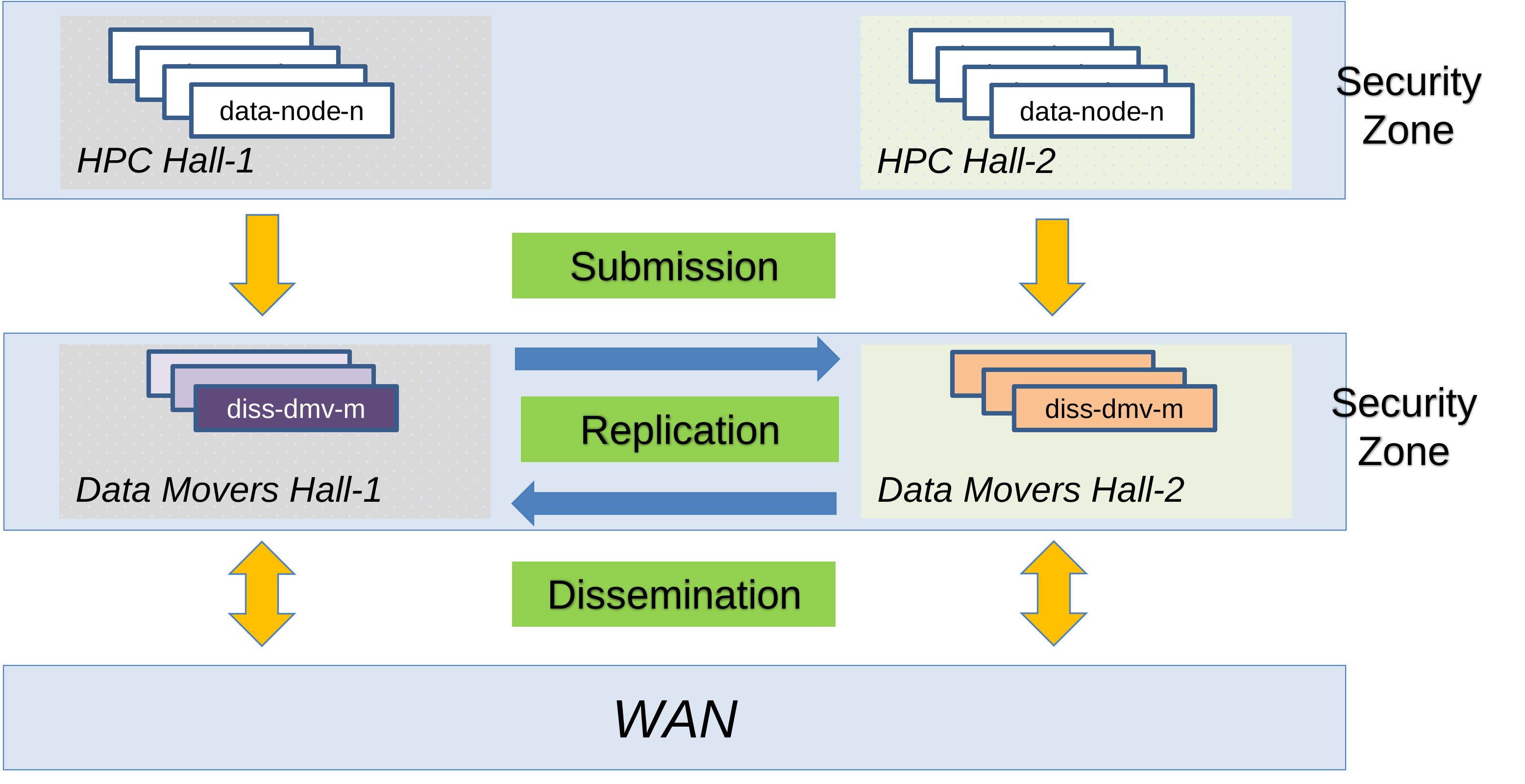
Application Delivery Controllers (ADCs) load-balance incoming Data Portal traffic across the available Data Movers. This distributes connection workloads rather than concentrating them on a single portal machine, allowing capacity to scale across the mover infrastructure.
ADC load balancing and the Master Server's allocation decisions operate at different levels. The ADC selects the User Data Mover that accepts a client's connection; the Master allocates the Target Data Mover where content is stored or retrieved. These need not be the same machine. See Components and the Data Portal workflow.
High availability across two data halls
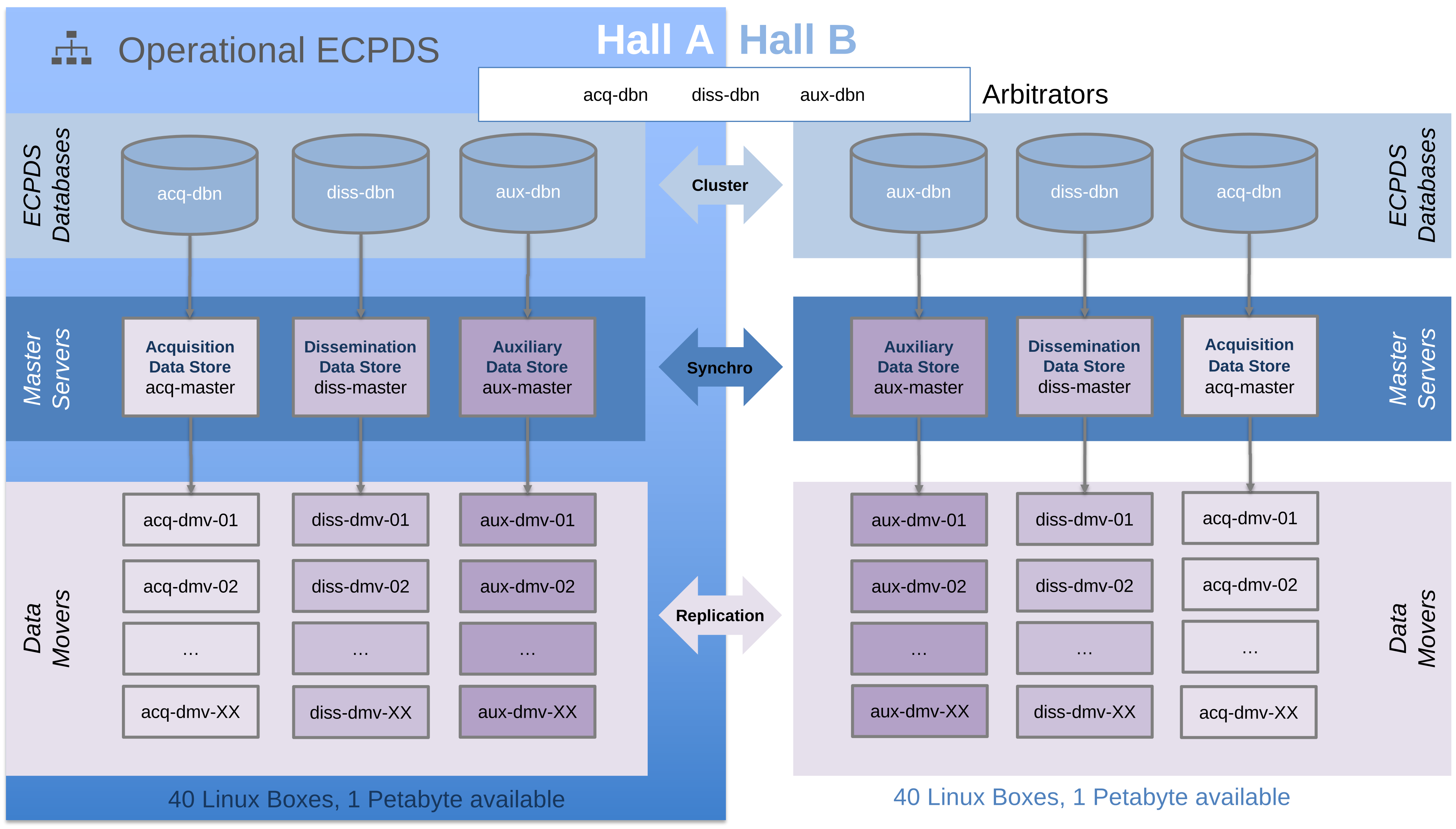
The infrastructure is distributed across two physically separate data halls. Data Movers are organised into pairs called transfer groups, with the two members of each pair placed in different halls.
Each transfer group replicates data between its two Data Movers. If one machine fails, its partner can take over the corresponding data-mover service. Placing partners in separate halls extends that protection beyond individual hardware failures: losing an entire hall does not also remove both members of a transfer group.
The distinction between having two machines and placing them in independent failure domains is important. Two replicas in the same hall would still be exposed to the same hall-level incident. Cross-hall placement is intended to avoid either a single physical mover or a single data hall becoming a point of failure for the corresponding mover service.
Replication protects the availability of file content, while ADC load balancing distributes incoming access across available movers. Neither mechanism alone provides the whole availability model: clients also need working network paths and the coordinating services. During a failure, surviving machines must absorb additional work, so resilience planning includes enough remaining capacity as well as redundant copies of data.
Note
High availability does not imply that every in-flight connection survives a failure. Clients may need to reconnect or retry, and replicated content must be available on the surviving mover. Replication is also not a substitute for backups or recovery procedures.
Database redundancy and quorum
ECPDS databases use MariaDB Galera clusters. Each cluster has three nodes, all on physical machines, distributed as follows:
| Location | Database placement |
|---|---|
| First data hall | One Galera node |
| Second data hall | One Galera node |
| Separate DHS zone | A third Galera node |
The third location is not simply another copy in one of the two halls. It provides an additional failure domain and allows the two surviving nodes to retain a majority when either data hall is lost, provided they can still communicate.
Quorum matters because redundant database nodes must agree on which part of the cluster can continue accepting writes. In a three-node cluster, two connected nodes can form the majority; a lone isolated node cannot safely provide the same write availability. Thus, cross-location placement provides both redundant database state and a quorum arrangement designed to tolerate a data-hall failure. It does not guarantee availability under every combination of node failures and network partitions.
The database holds coordination metadata, configuration and transfer history; file content is held by the Data Movers. Galera redundancy and transfer-group replication therefore protect different parts of the service and complement one another.
Dedicated Masters and separated monitoring access
ECPDS Masters run on their own fully dedicated physical machines, separating coordination and scheduling resources from the machines handling bulk data movement. These Master machines also host the monitoring services used for internal ECMWF access.
External monitoring access follows a different deployment pattern: externally accessible monitoring interfaces run on dedicated VMs in the appropriate external-access zone. They are deliberately separated from the internal infrastructure rather than exposing the internal monitoring services directly.
This is an intentional boundary, not a contradiction of the bare-metal core: the external monitoring interfaces are an access layer, while the core Masters, Data Movers and database nodes run on physical machines. Network-zone separation addresses exposure and access control; it is distinct from both throughput provisioning and data replication.
Performance is not the same as availability
Bare metal and high availability solve different problems:
| Design choice | Primary concern |
|---|---|
| Dedicated bare-metal Data Movers and Masters | Predictable resources and sustained performance |
| ADC distribution across available Data Movers | Sharing incoming workloads and scaling portal capacity |
| Transfer-group replication | Keeping file content available when a mover fails |
| Cross-hall placement of mover pairs | Avoiding a shared hall-level failure for both replicas |
| Three-node Galera clusters across two halls and the DHS zone | Database redundancy and majority quorum across locations |
| Separate external monitoring VMs | Separating external access from the internal infrastructure |
Performance comes from how individual components are provisioned and how work is distributed; availability comes from multiple independent components, replication and placement across failure domains. A powerful bare-metal machine alone remains a single point of failure. Conversely, redundant machines do not automatically provide sufficient throughput when one of them, or an entire hall, is unavailable.
These choices should therefore be evaluated together: normal-operation capacity, surviving capacity during failures, replication health, database quorum and network reachability all contribute to the service users actually experience.
Core components
| Component | Responsibility |
|---|---|
| Master Server | Central coordinator: authentication, metadata registration, scheduling, and Data Mover allocation. |
| Mover Server (Data Mover) | Connects to remote systems via transfer modules, stores and streams file content. |
| Monitor Server | Web-based monitoring and management interface. |
| Data Portal | Passive, incoming access (FTP/SFTP/SCP/HTTPS/WebDAV/S3) for remote sites. |
| Database | Persists destinations, hosts, transfers, and history. |
See Components for a detailed description of each.
Key cross-cutting mechanisms
- Failover in host selection — dynamically switching between available hosts when a connection fails.
- Lifecycle of a data transfer — the statuses a transfer passes through from submission to completion, including retries and failures.
- Continental Data Movers — geographically distributed movers that optimise dissemination by reducing latency and pre-replicating data.
- Centralised vs. Federated — how a centrally operated OpenECPDS service compares to organisations running their own independent instances, and why the two are compatible rather than competing.
- Data Ownership & Catalogue — how OpenECPDS' product/destination metadata and end-to-end traceability complement (rather than replace) dedicated product catalogue systems.
Modularity & protocols
The OpenECPDS software is modular, supporting new protocols through extensions. It interacts with a variety of environments and supports multiple standard protocols:
- Outgoing connections (Data Acquisition & Dissemination): FTP, SFTP, FTPS, HTTP/S, WebDAV, Amazon S3, Azure and Google Cloud Storage.
- Incoming connections (Data Portal): FTP, SFTP, SCP, HTTPS, WebDAV, S3.
See Protocols & Connections and the Transfer Modules reference for details.
Object storage
OpenECPDS stores data as objects, combining data, metadata, and a globally unique identifier. It employs a file-system-based solution with replication across multiple locations to ensure continuous data availability. The object storage system is hierarchy-free but can emulate directory structures when necessary. See Object Storage.